

Attorney Advertising. This article was prepared with the assistance of artificial intelligence and reviewed by Oaks Law Firm prior to publication.
Rear end accident fault rules establish that the driver who strikes another vehicle from behind is legally presumed negligent in nearly every U.S. state, including California. That presumption is powerful, but it is not absolute. Specific exceptions, including unexpected sudden stops, mechanical failures, and illegal lead vehicle positioning, can shift or share liability. California Vehicle Code Section 21703 codifies the duty to maintain a safe following distance, and cases like Birge v. Charron (2012) and Sorel v. Koonce (2011) define where the presumption holds and where it breaks down. Understanding these rules is the first step toward protecting your rights and evaluating your compensation options.
How is fault determined in a rear end accident?
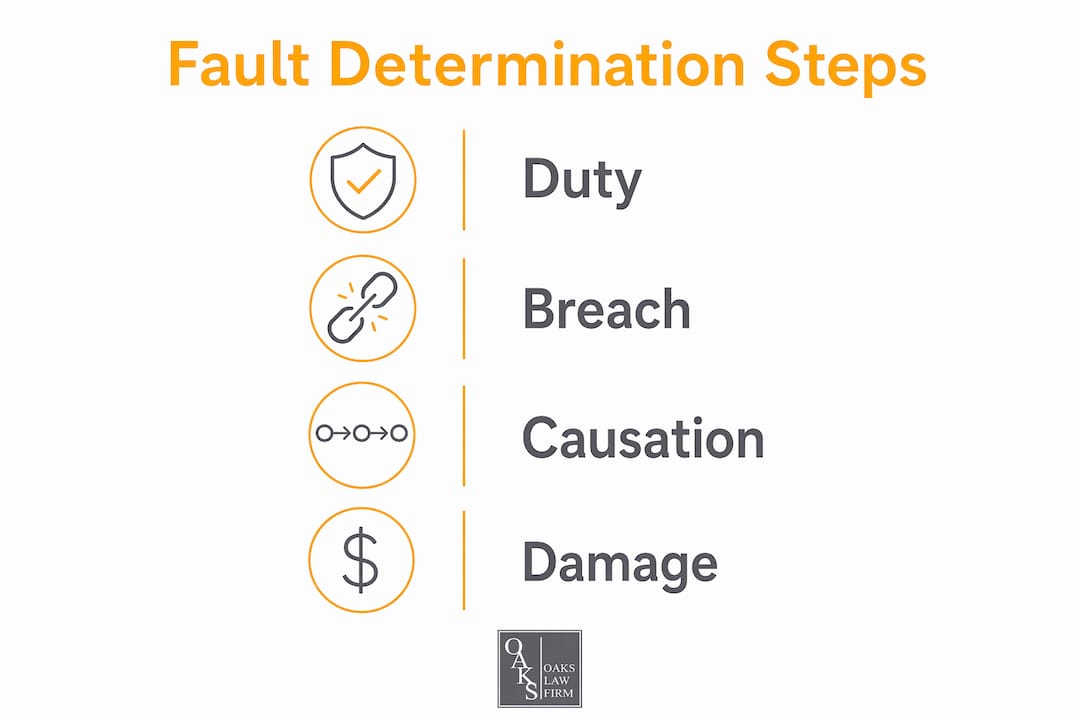
Fault determination in a rear end collision follows the four-element negligence test: duty, breach, causation, and damages. Every driver has a legal duty to maintain safe following distance. A rear driver who tailgates or drives distracted breaches that duty. When that breach directly causes a crash and results in injuries or property damage, all four elements are satisfied and liability attaches.
California Vehicle Code Section 21703 requires drivers to not follow another vehicle more closely than is reasonable. The widely recognized “three-second rule” gives drivers a practical benchmark: if you cannot count three full seconds between your front bumper passing a fixed point and the vehicle ahead passing the same point, you are following too closely. Adverse conditions like rain, fog, or heavy freeway traffic require an even greater gap.
What evidence is used to assign fault?
Insurers and courts rely on several categories of evidence to assign fault percentages:
- Police reports: Officers document their observations, cite traffic violations, and record driver and witness statements. These reports carry strong evidentiary weight, though they are not final legal determinations of fault.
- Dashcam and smartphone footage: Video evidence captures vehicle speeds, following distances, and driver behavior in real time.
- Witness testimony: Independent witnesses who saw the crash from outside either vehicle provide credible, neutral accounts.
- Vehicle damage patterns: The location and severity of damage help reconstruct the sequence of events.
- Skid marks and road conditions: Physical evidence at the scene can confirm or contradict driver accounts.
Insurance adjusters use specialized software and this body of evidence to assign fault percentages. That means fault is a negotiated conclusion shaped by evidence, not a fixed judgment handed down automatically.
Pro Tip: Request a copy of the police report within days of the crash. Errors in officer observations or citations can be corrected by filing a supplemental report, a step most accident victims never take.
Negligence per se is another important concept here. When a driver violates a traffic statute, like a tailgating law, that violation is treated as automatic evidence of negligence. The injured party does not need to separately prove the driver failed to act reasonably. The statute violation does it for them.
What circumstances can shift fault away from the rear driver?
The rear driver’s presumption of fault is rebuttable. Courts and insurers recognize specific situations where the lead driver’s actions or external conditions bear significant responsibility for the crash.
-
Unexpected sudden stops. Sorel v. Koonce (2011) clarified that routine stops at red lights or stop signs do not rebut the rear driver’s presumption of fault. Drivers are expected to anticipate normal traffic stops. However, a sudden, unjustified stop with no traffic reason can shift fault to the lead driver.
-
Brake checking. When a lead driver intentionally slams the brakes to intimidate or retaliate against a following driver, that act is treated as intentional negligence. Courts often assign significant shared liability to the lead driver in these cases.
-
Non-functioning brake lights. A rear driver who cannot see a stop signal has reduced ability to react. If the lead vehicle’s brake lights were broken or defective, that mechanical failure increases the lead driver’s share of fault.
-
Mechanical failure in the rear vehicle. Sudden brake failure or a blown tire that causes a rear driver to lose control can reduce or eliminate that driver’s liability, provided the failure was not caused by negligence in vehicle maintenance.
-
Illegal stopping or positioning. A lead vehicle stopped illegally in a travel lane, on a freeway shoulder without hazard lights, or in a no-stopping zone creates an unexpected hazard. That illegal positioning shifts fault toward the lead driver.
-
Unsafe lane changes. When the lead driver cuts into a lane without adequate space and the rear driver has no time to react, the lead driver bears primary responsibility for the resulting collision.
-
Reversing into traffic. A lead driver who backs up unexpectedly places the rear driver in an impossible position. This scenario typically assigns fault to the reversing driver.
Dashcam footage is the most compelling evidence to prove these exceptions. Video can demonstrate brake checking, illegal lane changes, or sudden reversals in ways that witness memory alone cannot match.
Pro Tip: If you believe the lead driver brake-checked you or made an illegal maneuver, preserve any dashcam footage immediately. Overwriting that video before it is downloaded is one of the most common and costly mistakes rear-end accident victims make.
How do state negligence laws affect fault and compensation?
Your state’s negligence framework determines how much of your damages you can actually recover, even after fault is established. Four distinct systems operate across the U.S., and each produces very different financial outcomes.
| Negligence framework | States | Effect on recovery |
|---|---|---|
| Pure contributory negligence | 4 states plus D.C. | Any fault on your part, even 1%, bars all recovery |
| Modified comparative (51% bar) | About 23 states | You recover if your fault is 50% or less; recovery is reduced by your percentage |
| Modified comparative (50% bar) | About 10 states | You recover if your fault is less than 50%; recovery is reduced by your percentage |
| Pure comparative negligence | About 12 states | You recover even if mostly at fault; damages are reduced by your fault percentage |
California applies pure comparative negligence. That means even if you are found 80% at fault for a rear end crash, you can still recover 20% of your total damages. This is one of the most plaintiff-friendly frameworks in the country.
The practical impact is significant. A driver in Virginia, which uses contributory negligence, who is found even 5% at fault recovers nothing. That same driver in California recovers 95% of their damages. Knowing your state’s rule shapes every decision you make about whether to negotiate, settle, or litigate.
Chain-reaction crashes add another layer of complexity. A middle driver pushed into the vehicle ahead by a rear impact is typically not at fault for the forward collision. However, if that middle driver had been following too closely before the initial impact, they can share liability for the forward collision as an independent violation. Fault apportionment in multi-vehicle crashes depends on the sequence of events and each driver’s specific conduct.
No-fault states add a separate layer. In those states, your own insurance covers your medical bills up to a threshold regardless of who caused the crash. To step outside the no-fault system and sue the at-fault driver directly, your injuries typically must meet a defined severity threshold, such as a permanent injury or medical bills exceeding a set dollar amount.
Practical steps to protect your rights after a rear end crash
The actions you take in the first hours after a rear end collision directly affect your ability to contest fault and recover compensation. Evidence disappears fast. Memories fade. Witnesses leave.
- Photograph everything at the scene. Capture all vehicle positions, damage to both cars, skid marks, road conditions, traffic signals, and any debris. Take photos from multiple angles and distances.
- Gather witness contact information. Get names and phone numbers from anyone who saw the crash before they leave. Independent witnesses are among the most persuasive sources of evidence in a fault dispute.
- Call the police and get a report number. A police report documents the scene while evidence is fresh. Review the report carefully once it is available and request a supplemental report if it contains factual errors.
- Preserve dashcam footage immediately. Download or back up any dashcam or smartphone video before it is overwritten. This is often the single most valuable piece of evidence in a contested fault case.
- Seek medical attention the same day. Even if you feel fine, some injuries like whiplash and soft tissue damage appear hours or days later. A same-day medical record ties your injuries directly to the crash.
- Avoid admitting fault. Do not apologize or speculate about what happened when speaking to police, the other driver, or insurance adjusters. Statements made at the scene can be used against you later.
- Report the crash to your insurer promptly. Most policies require timely reporting. Delayed reporting can give the insurer grounds to reduce or deny your claim.
- Consult an attorney before accepting any settlement. Insurance companies have financial incentives to minimize payouts. An attorney can evaluate whether a settlement offer reflects the full value of your claim.
California’s general statute of limitations for personal injury claims is two years from the date of the accident under California Code of Civil Procedure Section 335.1. If a government entity is involved, you must file a government tort claim within six months under Government Code Section 911.2. Missing these deadlines eliminates your right to recover, regardless of how strong your case is.
Pro Tip: Document your injuries with photos every day for the first two weeks after the crash. Progressive bruising and swelling that appears days later is powerful evidence against insurers who argue the impact was too minor to cause real harm.
For a detailed walkthrough of documenting your injuries after a Los Angeles crash, Oakslawfirm has published a step-by-step guide that covers photos, medical records, and witness statements.
Key Takeaways
Rear end accident fault rules create a strong legal presumption against the rear driver, but specific evidence can shift or share liability, and your state’s negligence framework determines how much you can actually recover.
| Point | Details |
|---|---|
| Rear driver presumed at fault | The presumption applies in nearly every state but is rebuttable with evidence of sudden stops, brake checking, or mechanical failure. |
| Four-element negligence test | Duty, breach, causation, and damages must all be proven; California Vehicle Code Section 21703 establishes the following-distance duty. |
| State law shapes recovery | California’s pure comparative negligence allows recovery even with partial fault; contributory negligence states bar all recovery at 1% fault. |
| Evidence is everything | Dashcam footage, witness statements, and police reports are the primary tools for contesting or confirming fault assignments. |
| Deadlines are firm | California’s two-year statute of limitations (CCP §335.1) and six-month government claims deadline (Gov. Code §911.2) cannot be extended after they pass. |
What I’ve learned about rear end fault cases after two decades in California courts
By Matthew Nezhad
The most common mistake I see after a rear end crash is accepting the initial fault determination as final. Clients come to me weeks after the accident having already told the insurance adjuster “I was following too close” or having signed a recorded statement they did not fully understand. By that point, the insurer has locked in a narrative that is very hard to change.
The presumption of fault against the rear driver is real, but it is a starting point, not a verdict. I have handled cases where dashcam footage completely reversed the insurer’s initial fault assignment. In one case, the lead driver had brake-checked my client three times before the final impact. Without that video, my client would have been stuck with full liability. With it, we established shared fault and recovered significant compensation.
The MIST defense is the other tactic I see constantly. Insurers argue that because the vehicle damage looks minor, the injury must be minor or fabricated. The eggshell plaintiff doctrine directly counters this. An at-fault driver takes the victim as they find them. If a low-speed impact aggravates a pre-existing spine condition, the at-fault driver is responsible for that aggravation. Strong medical documentation and, when needed, expert medical testimony are what defeat the MIST defense.
My practical advice: treat the scene of the crash as a crime scene. Document everything before you move your car. Call an attorney before you give a recorded statement to any insurer, including your own. The evidence you gather in the first 24 hours often determines the outcome of the entire case.
— Matthew Nezhad
How Oakslawfirm can help you fight a fault dispute
A rear end crash can leave you dealing with injuries, vehicle damage, and an insurance company that is already working to minimize what it pays you. Oakslawfirm has spent over two decades protecting injury victims throughout the San Fernando Valley and California, handling cases involving car accident compensation, uninsured and underinsured drivers, and wrongful death. Attorney Matthew Nezhad and his team know how to gather the evidence that shifts fault determinations and how to negotiate with insurers who use tactics like the MIST defense to undercut legitimate claims. If you were involved in a rear end collision and want to understand your legal options, contact Oakslawfirm for a free case evaluation. There is no cost to speak with us, and no obligation to proceed.
FAQ
Who is at fault in a rear end accident?
The rear driver is legally presumed at fault in nearly every U.S. state because they have a duty to maintain a safe following distance. That presumption can be rebutted with evidence of sudden stops, brake checking, or mechanical failure by the lead driver.
Can the front driver be at fault in a rear end collision?
Yes. If the lead driver brake-checked, made an illegal lane change, reversed into traffic, or had non-functioning brake lights, they can bear significant or primary fault for the crash.
How does California’s negligence law affect my rear end accident claim?
California uses pure comparative negligence, which means your damages are reduced by your percentage of fault but never eliminated entirely. Even a driver found 70% at fault can recover 30% of their total damages.
What evidence helps contest fault in a rear end crash?
Dashcam footage is the most powerful tool for rebutting fault presumptions. Witness statements, police reports, vehicle damage photos, and medical records also play a critical role in fault disputes.
How long do I have to file a rear end accident claim in California?
California’s statute of limitations for personal injury claims is two years from the date of the accident under CCP §335.1. If a government entity is involved, you must file a government tort claim within six months under Gov. Code §911.2.
Legal Disclaimer: The information provided in this article is for general informational purposes only and does not constitute legal advice. Reading this article does not create an attorney-client relationship between you and Oaks Law Firm. Every case is unique, and the outcome of any legal matter depends on the specific facts and applicable law. You should consult a qualified attorney for advice regarding your individual situation. Oaks Law Firm makes no guarantees about the outcome of any case.
