
A commercial vehicle accident claim is a formal legal process where an injured party seeks compensation after an accident involving a vehicle used for business purposes. These claims are governed by a distinct set of federal regulations, higher insurance limits, and more complex liability rules than standard personal vehicle claims. Understanding how this process works gives you a real advantage when dealing with insurance carriers and corporate legal teams that move fast.
Disclaimer: This article provides general information only. Your specific case facts, jurisdiction, and circumstances may produce different outcomes. Consult a licensed attorney for advice tailored to your situation.
What is a commercial vehicle accident claim?
A commercial vehicle accident claim is the legal mechanism through which an injured person recovers damages after a crash involving a business-operated vehicle. The term “commercial vehicle accident claim” is the everyday phrase most people search for. The recognized industry term is a commercial motor vehicle (CMV) liability claim, and both refer to the same process under federal and state law.
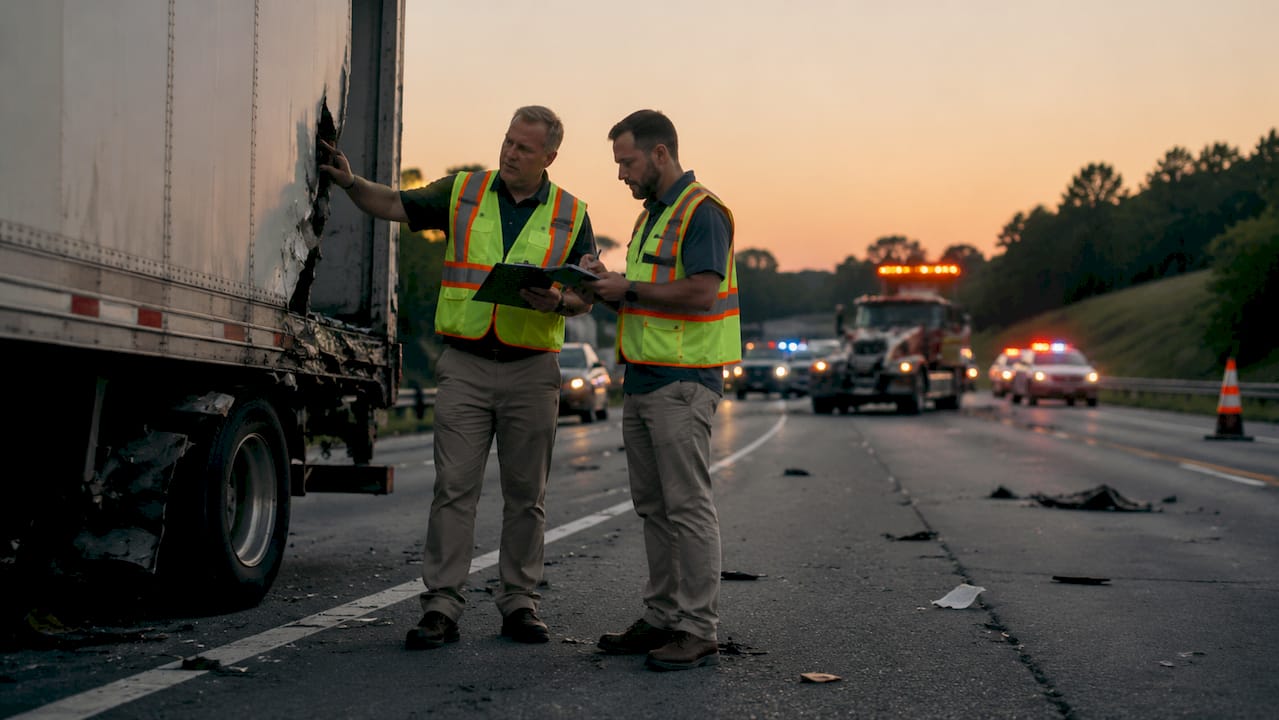
These claims differ from personal auto claims in three fundamental ways: the vehicles involved carry much higher insurance minimums, multiple parties can share legal liability, and federal Department of Transportation regulations apply to the vehicles and their operators. That combination makes commercial claims significantly more complex and potentially more valuable than a standard fender-bender claim.
Oakslawfirm has handled these cases throughout Los Angeles and California for over two decades. The firm’s experience shows that claimants who understand the process early recover more and make fewer costly mistakes.
What is a commercial vehicle accident claim?
A commercial vehicle accident claim is the legal mechanism through which an injured person recovers damages after a crash involving a business-operated vehicle. “Commercial vehicle accident claim” is the everyday phrase most people search for. The recognized industry term is a commercial motor vehicle (CMV) liability claim, and both refer to the same process under federal and California law.
These claims differ from personal auto claims in three fundamental ways: the vehicles involved carry much higher insurance minimums, multiple parties can share legal liability, and federal Department of Transportation regulations apply to the vehicles and their operators. That combination makes commercial claims more complex than a standard fender-bender claim.
Oaks Law Firm handles these cases throughout the and across California. In our experience, claimants who understand the process early tend to make fewer costly mistakes along the way.
What qualifies as a commercial vehicle and why does it matter?
The classification of a vehicle as “commercial” directly determines which insurance rules, liability standards, and federal regulations apply to your claim. Getting this classification right is the first step in building a strong case.
The Federal Motor Carrier Safety Administration (FMCSA) defines a commercial motor vehicle as any vehicle used in interstate commerce that meets one of the following criteria:
- Gross vehicle weight rating (GVWR) of 10,001 pounds or more
- Designed to transport 9 or more passengers (including the driver) for compensation
- Designed to transport 16 or more passengers (including the driver) regardless of compensation
- Used to transport hazardous materials in quantities requiring placards
Common examples include semi-trucks, tractor-trailers, delivery vans, box trucks, tanker trucks, and company-owned passenger vehicles used for business travel. A rideshare vehicle operating on a commercial platform can also qualify under certain rules.
The classification matters because it triggers a separate legal and regulatory framework. FMCSA rules govern driver hours of service, vehicle maintenance logs, and cargo loading standards. California adds its own layer of oversight through the California Highway Patrol (CHP) commercial vehicle inspection program. When a driver or company violates these regulations, those violations can become direct evidence of negligence in your claim.
Federal and state regulations add layers of complexity to commercial cases. Understanding employer responsibility for negligent practices is an important part of evaluating who may be accountable.
How does a commercial vehicle accident claim differ from a personal vehicle claim?
The core difference is the number of parties who can be held legally responsible. In a personal vehicle accident, liability typically falls on one driver. In a commercial vehicle case, liability often extends beyond the driver to employers, cargo loaders, and maintenance contractors, creating more complex legal scenarios.
That expanded liability pool changes how a claim is investigated and negotiated. Here is how the differences play out in practice:
Multiple liable parties. The trucking company may be responsible for negligent hiring or scheduling. A third-party cargo loader may share fault if improper loading contributed to the crash. A maintenance contractor may be responsible if a mechanical failure played a role in the collision.
Rapid-response insurance teams. Adjusters often begin their investigation while the injured party is still receiving treatment. These teams work to build a defense before you have gathered your own evidence.
Longer, more document-heavy timelines. Commercial claims involving serious injuries, disputed liability, or multiple defendants tend to take longer to resolve than a simple two-car claim, in part because of the volume of records involved. How long any particular claim takes depends entirely on its specific facts.
Regulatory investigation records. FMCSA logs, driver qualification files, electronic logging device (ELD) data, and vehicle inspection reports can all become part of the evidence record. Personal vehicle claims have no equivalent documentation layer.
Pro Tip: Consider speaking with a commercial vehicle attorney before giving any statement to an insurance adjuster. Corporate carriers often have legal teams working from day one.
The truck accident liability picture in commercial cases is rarely simple. Knowing who may be named in a claim, and why, can affect the strength of that claim.
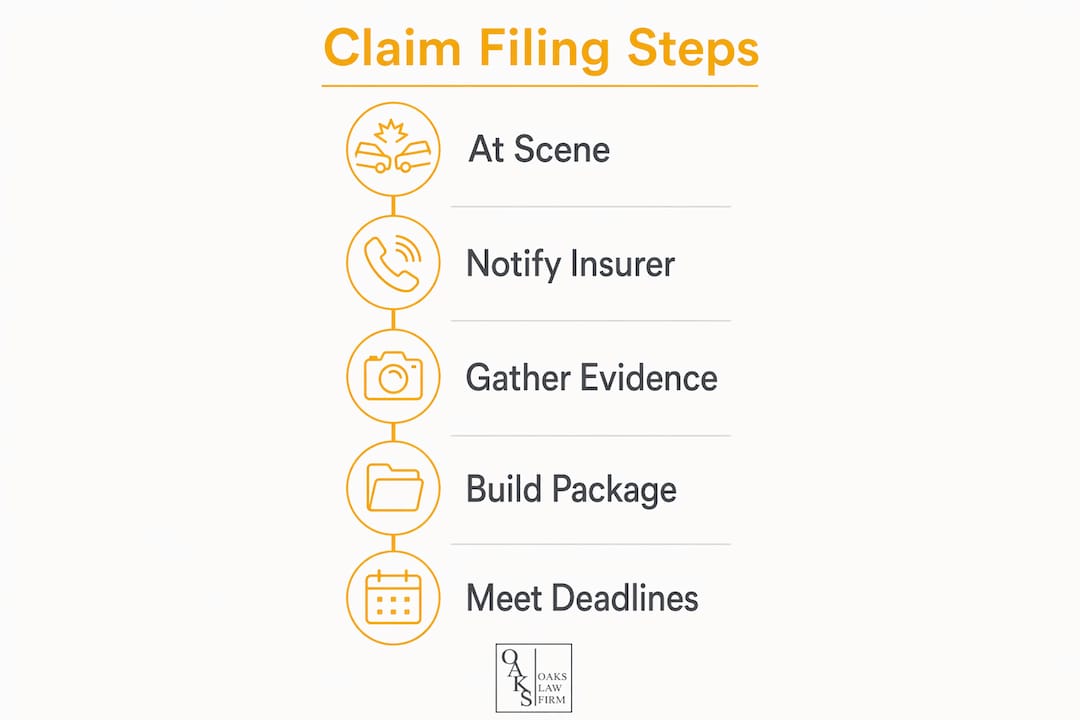
How to file a commercial vehicle accident claim in California: step by step
At the accident scene
Filing a commercial accident claim correctly from the start helps protect your right to seek full compensation. Mistakes made in the first days are often the hardest to fix later.
At the accident scene
Document everything before vehicles are moved, if it is safe to do so. Take photos of all vehicles, license plates, DOT numbers displayed on commercial vehicles, road conditions, skid marks, and any visible injuries. Collect the driver’s commercial license number, employer name, and insurance carrier information. Avoid admitting fault or making statements about how you feel physically. Adrenaline can mask pain, and early admissions can complicate your claim.
Notify your insurer promptly
Notifying your insurer promptly after a crash is important because many commercial policies contain “late notice” provisions that can jeopardize coverage if notification is delayed. Report the accident factually and briefly. Avoid speculating about fault or describing injuries in detail at this early stage.
Build your demand package
One of the most important documents in the claim process is the demand package. A thorough demand package generally includes police reports, medical documentation, proof of lost wages, and future-treatment narratives. Thorough early documentation limits the insurer’s ability to undervalue or deny a claim.
Your demand package should generally include:
- Police and accident reports from all responding agencies
- Medical records and bills covering all treatment from the date of the accident forward
- Proof of lost wages, such as pay stubs, employer letters, or tax records
- Future-treatment estimates from your treating physicians
- Photos and video from the scene and of your injuries over time
- Witness statements collected as close to the accident date as possible
- FMCSA and ELD records obtained through formal preservation letters or discovery
Know your legal deadlines in California
In California, the general statute of limitations for most personal injury claims is two years from the date of injury under Code of Civil Procedure § 335.1. This same two-year window generally applies to crashes involving commercial vehicles.
That general rule has significant exceptions. The most important involves claims against a government entity — for example, a crash with a city sanitation truck, a public transit vehicle, or a government-owned vehicle. In those cases, the California Government Claims Act (Government Code § 911.2) generally requires a formal written claim to be presented to the public entity within six months of the incident, before any lawsuit can even be filed. Other circumstances can also change the timeline. Because these deadlines can vary depending on who is responsible for the injury, it is important to act quickly and confirm your specific deadline with an attorney as soon as possible. Missing the applicable deadline can end your right to sue entirely.
Pro Tip: Consider sending a preservation letter to the trucking company soon after the accident. A preservation letter puts the company on notice to retain ELD data, maintenance logs, and driver records that may otherwise be deleted on routine schedules.
Track your claim’s progress in writing. Following up every phone call with a confirming email creates a written record that can protect you if the insurer later disputes what was discussed.
Common challenges when navigating a commercial vehicle accident claim
Commercial vehicle claims tend to attract well-funded opposition. Knowing the tactics insurers use gives you a real chance to respond to them.
Defense teams move quickly. Adjusters may begin building their case while you are still recovering — photographing the scene, interviewing witnesses, and downloading vehicle data before you have retained an attorney. This head start is intentional.
Recorded statements can be used against you. Recorded statements taken soon after an accident are often used by insurers to minimize claims. Early statements made without full medical information can reduce a claim’s value. It is generally wise to wait until you have complete medical documentation and legal counsel before giving any recorded statement.
Denial tactics are common. Insurers may argue the driver was an independent contractor rather than an employee, shifting liability. They may claim a separate company loaded the cargo. They may dispute the severity of your injuries by pointing to gaps in treatment. Each of these tactics calls for a specific, documentation-backed response.
Documenting injuries properly from the moment of the accident is one of the most effective defenses against insurer denial tactics. Gaps in medical records are a common reason insurers give for reducing settlement offers.
What types of compensation may be available in a commercial vehicle accident claim?
California law allows recovery for both economic and non-economic damages. The categories below are typical of what an injured person may pursue. Whether any particular category applies, and what any claim is ultimately worth, depends entirely on the specific facts of the case.
| Damage type | What it covers | Typical evidence |
|---|---|---|
| Medical expenses | Hospital bills, surgery, therapy, future care | Medical records, physician estimates |
| Lost wages | Income lost during recovery | Pay stubs, employer letters, tax returns |
| Pain and suffering | Physical pain and emotional distress | Medical records, personal journal, testimony |
| Property damage | Vehicle repair or replacement | Repair estimates, photos, valuation data |
| Wrongful death | Funeral costs, lost financial support | Death certificate, financial records |
Most personal injury claims resolve through negotiation rather than trial, which means documentation and legal strategy often play a central role in how a claim is decided. The strength of your medical records, the clarity of liability, and the number of responsible parties all factor into how a claim develops. Because every case is different, no one can tell you in advance what your claim is worth — that is a question that can only be answered by looking closely at your specific situation.
The California compensation framework allows recovery for both economic and non-economic damages. Understanding which categories apply to your injuries is the foundation of a strong demand package.
Key takeaways
A commercial vehicle accident claim is one of the more legally complex injury claims you can file in California, and how thoroughly you act in the days after the crash can matter a great deal.
| Point | Details |
|---|---|
| Classification drives the claim | Vehicles meeting FMCSA weight or passenger thresholds trigger federal regulations and higher insurance limits. |
| Multiple parties may share liability | Employers, cargo loaders, and maintenance contractors can all potentially be named in a commercial vehicle claim. |
| Notify your insurer promptly | Late-notice clauses can jeopardize coverage, so report the accident promptly and in writing. |
| Build a complete demand package | Police reports, medical records, proof of lost wages, and future-treatment estimates all strengthen a claim. |
| Most cases settle out of court | Because most claims resolve through negotiation, documentation and legal strategy are often the deciding factors. |
Oaks Law Firm is ready to help with your commercial vehicle claim
If you were injured in an accident involving a commercial vehicle, the legal process ahead is more complex than a standard car accident case. Oaks Law Firm represents injured people throughout the and across California, including in cases involving semi-trucks, delivery vehicles, and company-operated cars.
Our team understands how to respond to aggressive insurance defense tactics, work to preserve critical evidence, and build demand packages designed to hold up under scrutiny. Our firm handles personal injury matters on a contingency-fee basis, which means you generally pay no attorney’s fees unless we recover for you; case costs and expenses may be handled separately, and we are glad to explain how that works during your consultation. Contact Oaks Law Firm today for a free, no-pressure case evaluation to learn where you stand.
This article is provided for general informational purposes only and does not constitute legal advice. The information presented may not reflect the most current legal developments and should not be relied upon as a substitute for consultation with a licensed attorney. Every personal injury case involves unique facts and circumstances, and the outcome of any case depends entirely on those specific facts. Any results, settlement amounts, or verdicts referenced in this content are specific to the individual cases described, are not typical, and do not guarantee, promise, or predict a similar outcome in your case. Reading this content does not create an attorney-client relationship with Oaks Law Firm. Contact us directly for a consultation specific to your situation.
FAQ
What is a commercial vehicle accident claim?
A commercial vehicle accident claim is a formal legal process where an injured person seeks compensation after a crash involving a vehicle used for business purposes. These claims often involve higher insurance limits, federal regulations, and multiple potentially liable parties.
How long do I have to file a commercial vehicle accident claim in California?
In general, California law gives you two years from the date of injury to file a personal injury lawsuit under Code of Civil Procedure § 335.1. Important exceptions exist — most notably, claims against a government entity generally require a written claim within six months under Government Code § 911.2. Because deadlines can vary based on who is responsible, confirm your specific deadline with an attorney as soon as possible.. Missing this filing deadline permanently eliminates your right to sue.
Who can be held liable in a commercial vehicle accident?
Liability can potentially extend to the driver, the employing company, cargo loaders, and maintenance contractors. Negligent hiring or scheduling by an employer is frequently a central issue in litigation and settlement negotiations.
Should I give a recorded statement to the insurance company?
It is generally wise to be cautious. Recorded statements taken shortly after an accident are routinely used by insurers to reduce claim value. Many people choose to wait until they have complete medical documentation and have consulted an attorney before giving any statement.
How much is a commercial vehicle accident claim worth?
There is no standard figure. The value of any claim depends entirely on the specific facts including injury severity, the clarity of liability, the number of responsible parties, and the quality of the documentation. The only reliable way to understand your claim’s potential value is to have your specific situation reviewed.
